
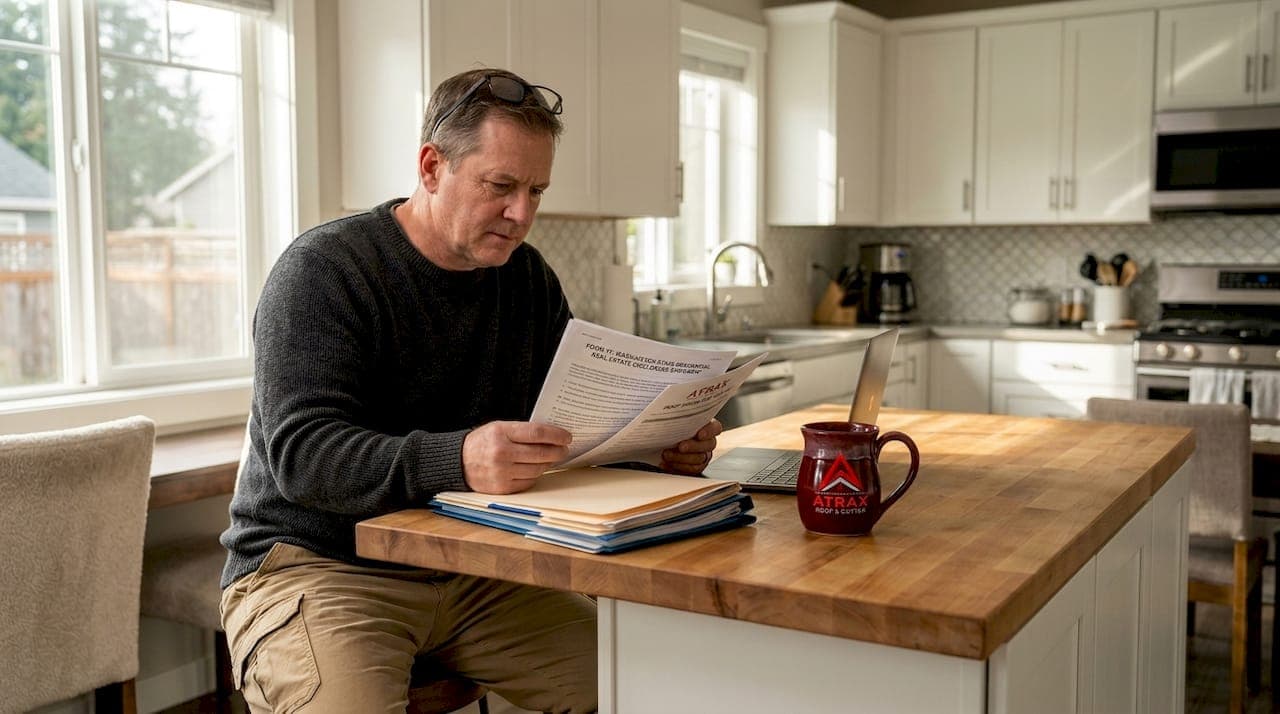
Selling your home in Washington State comes with real legal weight, especially when the roof is involved. Many sellers assume they must fix every roof issue before listing or that an "as-is" sale protects them from any liability. Both assumptions can cost you money or derail your closing. Understanding your seller roof repair obligations, the formal term used in real estate practice is "seller's repair obligations," gives you the clarity to make smart decisions, negotiate confidently, and protect yourself from disputes that can surface weeks after closing.
Table of Contents
- Key Takeaways
- Seller roof repair obligations under Washington disclosure law
- Navigating buyer inspection requests for roof repairs
- Risks and legal consequences of roof repair commitments
- How to strategically manage your roof disclosure and negotiation
- My honest take on handling roof obligations during a sale
- Get your roof sale-ready with Atraxroofandgutter
- FAQ
Key Takeaways
| Point | Details |
|---|---|
| Disclosure is legally required | Washington sellers must report all known roof issues on Form 17 based on actual knowledge at the time of signing. |
| Amendments can reopen the sale | If you learn new roof information after delivery of Form 17, you must amend it at least 3 business days before closing. |
| Three response options exist | After a buyer's inspection, sellers can agree to repairs, offer a credit, or decline the request entirely. |
| Vague promises create real risk | Repair agreements without defined scope, contractor, and standards are a leading cause of final walkthrough disputes. |
| "As-is" does not mean immune | Even as-is sales require full disclosure of known roof defects under Washington law. |
Seller roof repair obligations under Washington disclosure law
Washington State follows a strict disclosure framework governed by RCW 64.06.020. Every seller of a residential property must complete Form 17, the Seller Disclosure Statement, before or at the time of signing a purchase agreement. This form includes a dedicated section on roof condition, prior repairs, known leaks, and the approximate age of the roof. You are required to answer based on your actual knowledge, meaning what you genuinely know, not what an inspector might find.
This distinction matters. Sellers are not required to hire an inspector or conduct a formal evaluation before listing. However, you cannot strategically stay ignorant to avoid disclosure. If you know your roof had a leak two years ago, that it was patched by a handyman without a permit, or that it is approaching the end of its service life, that information belongs on Form 17.
Here is what Form 17 specifically requires you to address regarding the roof:
- Known roof leaks, current or past
- Previous roof repairs, including the nature and date of work
- Known defects in flashing, gutters, or drainage
- Age of the roof, if known
- Any active insurance claims related to roof damage
There is also a post-disclosure obligation that many sellers overlook. If you learn new adverse roof information after delivering Form 17, you must amend the disclosure. That amendment must be delivered at least 3 business days before closing. And here is the part that catches sellers off guard: that amendment reopens the buyer's right to rescind the contract for a full 3-business-day window. This is not a technicality. It can delay or kill a deal if it happens late in the transaction.
| Disclosure Trigger | Seller Obligation | Timing |
|---|---|---|
| Known roof issue at time of listing | Disclose on original Form 17 | Before or at signing |
| New issue discovered after Form 17 delivery | File a Form 17 amendment | At least 3 business days before closing |
| Issue resolved before disclosure is needed | Document and report corrective action | Prior to Form 17 delivery |
Navigating buyer inspection requests for roof repairs
Once your home is under contract and the buyer completes their inspection, roof issues often surface as repair requests. In Washington, buyers typically submit these through the Form 35 Inspection Addendum. Inspection contingencies give buyers the right to request repairs or credits, but sellers retain the right to respond on their own terms.
You have three main response options:
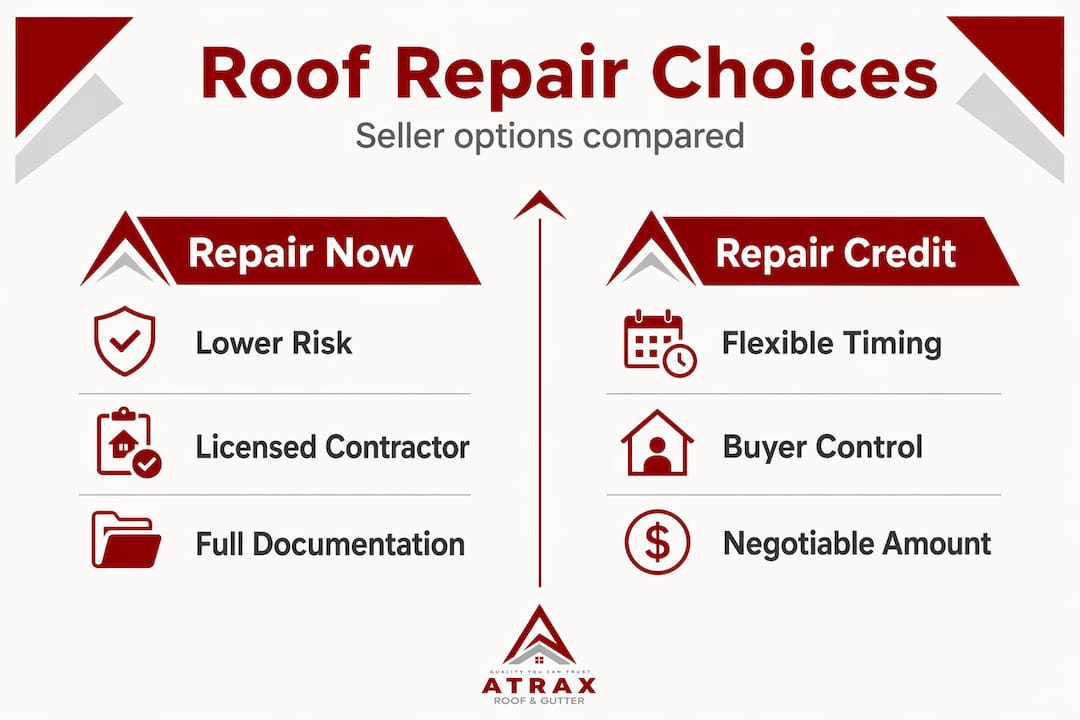
- Agree to the repair. You commit to having the specified roof work completed before closing. This resolves the request but creates new obligations, including choosing a contractor, setting a timeline, and meeting the buyer's standards.
- Counter with a credit. Instead of completing the repair yourself, you offer a reduction in purchase price or a closing cost credit. This gives the buyer control over the fix and removes you from the equation after closing.
- Decline the request. You can refuse the repair request entirely. This forces the buyer to decide whether to proceed without the repair, renegotiate, or walk away.
Each response carries real-world consequences. Agreeing to repairs sounds cooperative, but it puts you on the hook for quality and completion. Repair credits can simplify the transaction by giving buyers control and eliminating your exposure to post-repair disputes. Many experienced sellers in Washington prefer credits for significant roof work for exactly this reason.
If you do agree to repairs, the scope definition is everything. Agreements that only say "seller will repair roof" are where problems begin. You need to specify who performs the work, whether permits are required, what standard the work must meet, and how completion will be confirmed at the final walkthrough.
Pro Tip: When agreeing to roof repairs, include language in your agreement that defines completion as: licensed contractor, written invoice provided, all permits closed, and work completed no fewer than 5 business days before closing. This gives you a buffer to address any final walkthrough concerns without risking your closing date.
Risks and legal consequences of roof repair commitments
Committing to roof repairs in writing is a legal obligation, and Washington courts take that seriously. Vague repair commitments are the single biggest source of final walkthrough disputes between buyers and sellers. When the repair is ill-defined, the buyer's expectations almost always exceed what the seller thought they agreed to.

The timeline risk is just as real. Repair delays or poor quality work increase seller risk near closing, sometimes requiring a last-minute credit offer or full deal termination. If the buyer walks into the final walkthrough and the roof repair is incomplete or visibly substandard, they have grounds to push back hard, potentially demanding a credit or delaying closing while you scramble.
To protect yourself as a seller, focus on these practices:
- Hire only licensed, bonded roofing contractors for any agreed repairs
- Obtain permits when the scope of work requires them
- Keep all invoices, warranties, and completion documents
- Confirm work is finished well before the walkthrough date
- Have the contractor provide written documentation of work performed
"Even as-is sales require full disclosure of known roof defects; failure to disclose can lead to liability claims despite sale terms."
This matters because some sellers believe selling as-is eliminates their disclosure duties. It does not. If you knew your roof had active water intrusion and failed to include that on Form 17, you carry liability for that omission regardless of the sale terms. Post-closing disputes over undisclosed defects are among the most expensive legal situations a seller can face in Washington.
Documentation of roof repairs with permits, invoices, and warranties protects sellers if a buyer challenges the disclosure after closing. Think of paperwork as your insurance.
Pro Tip: Create a single folder, physical or digital, containing every roof-related document you have: past repair invoices, contractor names, permit records, and any insurance correspondence. Hand a copy to your real estate agent before listing. This builds buyer confidence and protects you legally.
How to strategically manage your roof disclosure and negotiation
The sellers who have the smoothest closings are not always the ones with the best roofs. They are the ones who prepare early, disclose clearly, and negotiate from a position of knowledge.
Start with a pre-listing roof inspection. A licensed roofing contractor can identify existing issues before buyers and their inspectors do. This gives you time to either repair problems on your schedule, budget accurately for what repairs might cost, or factor existing conditions into your listing price. Knowing the roof's actual condition also lets you complete Form 17 with confidence.
When completing Form 17, review it carefully with your real estate agent. Do not guess on items you are unsure about. Mark "don't know" when you genuinely do not have information, rather than leaving questions blank or answering inaccurately. Honesty here protects you. Understanding typical roof replacement costs before listing also helps you price accurately and know what repair credits are reasonable.
Here are practical approaches for managing your roof repair responsibilities during the sale:
- Complete Form 17 as accurately as possible with supporting documentation attached
- Obtain two to three written estimates before agreeing to any repair commitment
- Learn how to compare roofing estimates so you can assess proposals fairly
- Decide early whether you will handle repairs or offer credits for significant issues
- Schedule any agreed repairs with enough lead time to finish at least one week before closing
The credit vs. repair decision deserves careful thought. Repair credits are often preferable for sellers because they reduce liability and final walkthrough risk compared to direct repairs. If a buyer takes a credit and later has issues with their contractor, that is no longer your problem. If you did the repair yourself and it fails, you may still be responsible.
| Approach | Seller Risk Level | Best When |
|---|---|---|
| Complete roof repair before listing | Low, if done properly | Significant known defects exist |
| Offer repair credit after inspection | Medium low | Buyer wants control; you want clean close |
| Agree to repair post-inspection | Medium high | Minor, easily documented scope |
| Decline repair request | Variable | Roof is functional; price reflects condition |
My honest take on handling roof obligations during a sale
I have worked on roofs across Kirkland, Bothell, Bellevue, and Seattle for over a decade, and I have seen the same pattern play out too many times. A seller commits to fixing a roof issue without defining the scope clearly, the work gets rushed to meet closing, and the buyer shows up to the walkthrough with a list of complaints. Nobody wins in that situation.
In my experience, the sellers who get through transactions smoothly are the ones who front-load their honesty. They get an inspection done early. They disclose what they know without hesitation. They price or credit accordingly. Buyers respect that, and agents respect it too. It tends to shorten negotiations rather than lengthen them.
I am also a firm believer in the credit approach for anything beyond minor repairs. When you take on a repair commitment in a compressed closing timeline, you are betting on scheduling, weather, contractor availability, and buyer satisfaction all working in your favor. A credit removes most of that risk and keeps the deal moving. If the repair is truly minor, by all means handle it. But for anything involving a full section of roofing or water damage remediation, a credit usually protects you better.
The documentation habit is something I wish every seller started from day one of homeownership. Every invoice, every permit, every warranty for roof work should be in one folder. When it is time to sell, that paperwork turns a stressful conversation into a straightforward one. It shows buyers and their agents that the roof has been maintained honestly, and it protects you if questions arise later.
— Danyllo
Get your roof sale-ready with Atraxroofandgutter
If you are preparing to sell your Washington home and the roof is on your mind, Atraxroofandgutter is here to help you move forward with confidence. From pre-listing inspections to completing buyer-requested repairs before closing, our licensed and insured team handles the work professionally and on time.
We understand what sellers need: documentation, reliable workmanship, and completed jobs that hold up at final walkthroughs. Our professional roof repair services are designed to meet the exact standards required during real estate transactions, with written invoices and workmanship warranties included. If repair costs are a concern, we also offer financing options to help you manage the expense without disrupting your closing timeline. Serving Kirkland, Bothell, Redmond, Bellevue, Seattle, and surrounding communities, Atraxroofandgutter delivers the honest, quality work that protects your sale and your reputation. Contact us today for a free quote.
FAQ
What must Washington sellers disclose about the roof?
Washington sellers must disclose all known roof issues on Form 17, including past leaks, prior repairs, known defects, and approximate roof age. The duty is based on actual seller knowledge, not on what an inspector may discover.
Do sellers have to fix the roof before selling in Washington?
No. Washington sellers are not legally required to complete roof repairs before selling, but they must honestly disclose all known issues. Sellers can choose to repair, offer a credit, or sell as-is with proper disclosure.
What happens if a seller learns about a roof problem after signing?
If new adverse roof information arises after Form 17 is delivered, the seller must amend the disclosure at least 3 business days before closing. This amendment restarts the buyer's 3-business-day right to rescind the contract.
Can a seller decline a buyer's roof repair request?
Yes. Under Washington's Form 35 Inspection Addendum process, sellers can decline repair requests. The buyer must then decide whether to proceed with the purchase, renegotiate, or withdraw from the transaction.
Is a repair credit better than completing roof repairs before closing?
For significant roof work, a credit is often the smarter choice. Repair credits reduce seller liability and eliminate the risk of walkthrough disputes over workmanship quality or completion timing.