

Even if you cleaned your gutters last month, they can still overflow during a heavy Pacific Northwest rainstorm. That's not a failure on your part. It's a sign that something deeper is going on, whether it's a system that was never sized correctly, a slope that's slightly off, or a downspout elbow quietly blocking flow. Gutter overflow isn't just an annoyance. Water spilling over the edge can saturate your foundation, rot your siding, and wash out your landscaping. This guide breaks down exactly why it happens and what you can do about it right now.
Table of Contents
- Common causes of gutter overflow
- How roof size and rainfall affect your gutters
- Maintenance mistakes that still lead to overflow
- Do gutter guards prevent overflow?
- Proven solutions to prevent gutter overflow
- A local pro's perspective: Why most advice about gutter overflow falls short
- Gutter overflowing? Find your tailored solution today
- Frequently asked questions
Key Takeaways
| Point | Details |
|---|---|
| Overflow isn't just about clogs | Even clear gutters can overflow if they're too small for your roof or heavy rain. |
| Test after cleaning | Always check drainage with a hose to catch flow issues and hidden clogs. |
| Gutter guards aren't maintenance-free | Even the best guards need inspecting and can clog in Washington's stormy climate. |
| Proper sizing prevents problems | Matching gutter size to roof and rainfall stops most overflow issues for good. |
Common causes of gutter overflow
With the problem set, it's crucial to recognize exactly what leads to gutter overflow, even in freshly cleaned systems. Most homeowners assume overflow means clogged gutters. That's sometimes true, but it's far from the whole picture.
The most frequent causes we see in Washington homes include:
- Clogged gutters or downspouts from leaves, moss, and roof granules blocking water flow
- Undersized gutters or downspouts that simply can't move enough water during heavy rain events
- Poor slope or sagging sections that cause water to pool instead of drain
- Misaligned downspout elbows that create hidden blockages below the roofline
- Debris buildup in roof valleys that funnels concentrated water into one gutter section, overwhelming it
That last point surprises many homeowners. Roof valleys act like funnels. During a hard rain, they can channel two or three times more water than a flat section of roof into a single gutter run. If that gutter wasn't designed to handle the extra load, it will overflow regardless of how clean it is.
"Clean gutters are not the same as correctly sized gutters. A system that was installed for lighter rainfall years ago may simply be outmatched by today's storm intensity."
Here's a quick reference for understanding overflow triggers at a glance:
| Cause | Visible sign | Fix needed |
|---|---|---|
| Debris clog | Water spills over one section | Clean gutters and flush downspouts |
| Undersized system | Overflow along entire gutter run | Upsize gutters or add downspouts |
| Poor slope | Standing water after rain | Re-pitch gutter to proper angle |
| Downspout blockage | Water backs up near outlet | Clear elbow joints and extensions |
| Roof valley overload | Overflow at one concentrated spot | Add a larger section or diverter |
As the Gutter Capacity Guide confirms, undersized gutter capacity can cause overflow during heavy rain even when gutters are completely clear of debris. That's a critical point worth repeating.
How roof size and rainfall affect your gutters
After identifying the core overflow causes, let's examine how your home's characteristics and Washington's notorious rain work against most standard gutter designs.

Gutter sizing isn't guesswork. There's a real formula behind it. The basic calculation factors in your roof's drainage area (length times width of each roof plane), the pitch of your roof, and the design rainfall intensity for your area, measured in inches per hour. A steeper roof sheds water faster, which increases the effective drainage area. A higher rainfall intensity means more gallons per minute hitting your gutters at once.
Here's the problem for Washington homeowners. Many older homes were built with standard 4-inch or 5-inch K-style gutters sized for rainfall data that's now decades old. Gutter capacity depends on roof drainage area and design rainfall intensity, and if actual storm intensity exceeds what the system was designed for, available capacity drops and overflow occurs. Western Washington regularly sees rainfall events that exceed 1 inch per hour, and some storms push well past that.
| Roof drainage area | Recommended gutter size | Downspouts needed |
|---|---|---|
| Up to 750 sq ft | 4-inch K-style | 1 |
| 750 to 1,400 sq ft | 5-inch K-style | 1 to 2 |
| 1,400 to 2,500 sq ft | 6-inch K-style | 2 to 3 |
| Over 2,500 sq ft | 6-inch or larger | 3 or more |
These numbers assume moderate rainfall intensity. In the Seattle metro area and surrounding communities like Kirkland, Bothell, and Bellevue, you should size up one step from what these standard charts suggest. A 1,200 square foot drainage area that might work fine with a 5-inch gutter in Phoenix needs a 6-inch gutter here.
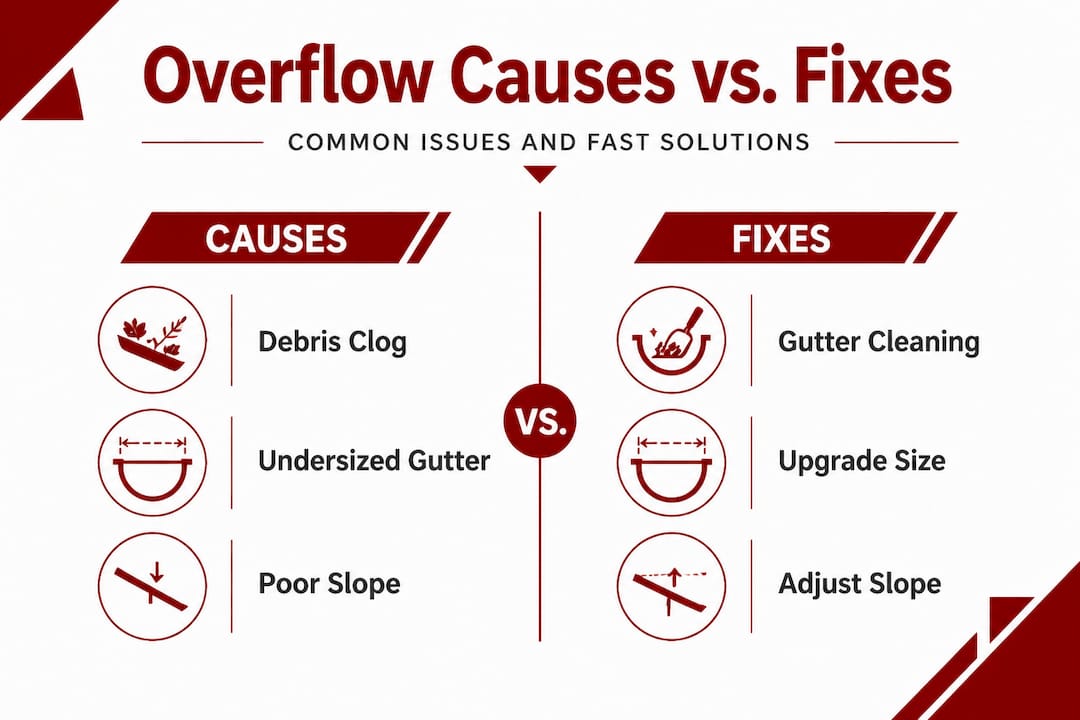
The takeaway: If your home is more than 20 years old and you've never had the gutter system evaluated, there's a real chance it was sized for conditions that don't reflect current storm patterns in your area.
Maintenance mistakes that still lead to overflow
But what if you've just cleaned your gutters and they still overflow? Let's unpack where the process often falls short.
Cleaning the gutters is only half the job. Here are the most common mistakes that leave homeowners frustrated even after a thorough cleaning:
- Not flushing the downspouts. Leaves and debris often compact inside the downspout, especially at the elbow joints near the bottom. Scooping out the gutter trough won't reveal this. You need to run water through the downspout to confirm it's clear.
- Skipping the slope check. Gutters should slope about a quarter inch for every 10 feet toward the downspout. Over time, hangers loosen and sections sag. A sagging section holds water and overflows even when everything else is clear.
- Ignoring the fascia board behind the gutter. Rotted or damaged fascia causes gutters to pull away from the roofline, creating gaps where water bypasses the gutter entirely.
- Cleaning only in fall and skipping spring. Spring brings pollen, seed pods, and leftover winter debris. Skipping a spring cleaning leaves your gutters partially blocked heading into the wet season.
- Not checking the downspout extensions. Extensions that drain too close to the foundation or are buried underground can back up and push water back into the system.
Pro Tip: After every cleaning, run a garden hose at the far end of the gutter and watch what happens. Verify actual drainage by running a hose so you can detect remaining clogs and confirm water flows toward the downspout instead of pooling. This one step catches problems that visual inspection misses every time.
Good gutter repair tips can help you address slope issues and hanger problems before they turn into bigger headaches. And if you're unsure about the condition of your roofline, reviewing roof maintenance steps alongside your gutter work gives you a much more complete picture of your home's drainage health.
Do gutter guards prevent overflow?
It's tempting to view gutter guards as a permanent fix, but expectations matter. Gutter guards are a helpful tool. They are not a solution to every overflow problem.
Here's what guards actually do well and where they fall short:
- They reduce large debris like leaves and twigs from entering the gutter trough
- They do not stop fine particles like roof granules, pollen, and shingle grit, which accumulate over time
- Micro-mesh guards are the most effective at blocking small debris but can still clog if not rinsed periodically
- Foam and brush-style guards trap debris inside the guard itself, sometimes making cleaning harder
- Improper installation angle causes guards to shed water over the edge instead of directing it into the gutter
Gutter guards are not guaranteed to eliminate maintenance. Even micro-mesh systems can clog over time depending on how they're installed and local conditions, so plan on periodic rinsing and cleaning with correct placement and slope.
The Pacific Northwest adds another layer of complexity. Moss and algae growth on guards is a real issue here. Organic material builds up on top of mesh guards, especially in shaded areas, and can eventually block water flow just as effectively as leaves.
Pro Tip: Even with the best gutter guards installed, plan on at least one annual inspection and rinse. If you have mature trees nearby, twice a year is smarter. Guards reduce maintenance. They don't eliminate it.
If your overflow problems persist despite having guards, the issue likely isn't debris at all. It may be time to consider gutter replacement with a properly sized system rather than continuing to maintain an undersized one.
Proven solutions to prevent gutter overflow
With realistic expectations about maintenance, it's time to get proactive with proven fixes and prevention strategies.
Follow these steps in order to diagnose and resolve overflow issues:
- Clear all debris from the gutter trough, including the areas directly around downspout openings where debris concentrates.
- Flush the downspouts with a garden hose at full pressure. If water backs up or drains slowly, there's a blockage inside the downspout or elbow joint.
- Check the slope by watching where water pools after flushing. Sections that hold standing water need to be re-pitched or have their hangers adjusted.
- Inspect the fascia and hangers for rot, rust, or looseness. A gutter that's pulling away from the house is a gutter that's not catching water correctly.
- Run a heavy hose test at peak flow to simulate a real rainstorm. If water spills over the front edge even with clear gutters, your system is undersized.
When upgrades become necessary, here's what to consider:
- Upgrading from 5-inch to 6-inch gutters increases capacity by roughly 40 percent, which makes a significant difference during peak storm events
- Adding a second downspout to a long gutter run reduces the distance water must travel and dramatically improves drainage speed
- Installing larger downspouts (3x4 inch rectangular instead of 2x3 inch) moves water out of the system faster
- Repositioning downspout outlets to better match where water naturally concentrates on your roof
As confirmed by the Gutter Capacity Guide, undersized downspout capacity causes overflow during heavy rain even with clear gutters. If you've done the maintenance and the overflow continues, sizing is almost certainly the issue.
For recurring overflow that maintenance alone doesn't solve, reaching out for professional gutter repair is the right call. A trained eye can identify slope problems, capacity gaps, and installation issues that are easy to miss from the ground. And if your system is aging or consistently undersized, a gutter system upgrade is often the most cost-effective long-term solution.
Schedule your gutter maintenance around Washington's wettest months. Late October through November and again in March are the two most important windows. Getting ahead of the rainy season instead of reacting to it keeps your home protected when it matters most.
A local pro's perspective: Why most advice about gutter overflow falls short
Generic national gutter advice is written for an average American home in an average American climate. Washington State is neither of those things. We've spent over 10 years working on roofs and gutters across Kirkland, Bothell, Redmond, Bellevue, Seattle, and the surrounding communities, and the patterns we see here are distinct.
Most online guides tell you to clean your gutters twice a year and call it done. That's reasonable advice for a dry climate. Here, it's the bare minimum. Western Washington's sustained rainfall events, combined with heavy moss growth, roof granule shedding, and the sheer volume of evergreen debris, create conditions that overwhelm standard maintenance schedules and standard gutter sizes.
What we find most often isn't a dirty gutter. It's a gutter that was installed 20 or 30 years ago to a specification that made sense at the time but doesn't match the home's current roofline, the surrounding tree coverage, or the intensity of modern storm events. The homeowner has been faithfully cleaning it twice a year and still gets overflow every November. That's not a maintenance failure. That's a capacity problem.
The other thing most guides miss is slope. A gutter that's level or slightly back-pitched looks fine from the ground and feels clean to the touch, but it holds water and creates overflow at the low spots. Checking slope requires a level and some patience. It's not glamorous work, but it's one of the highest-value checks you can do.
Our gutter repair insights come from seeing these patterns repeat across hundreds of homes. The fix is almost always a combination of proper maintenance and an honest assessment of whether the system was ever right for the house in the first place. When both of those things are addressed together, overflow problems go away and stay away.
Gutter overflowing? Find your tailored solution today
If your gutters are still overflowing after cleaning, the problem likely goes deeper than debris. At Atrax Roof & Gutter, we've helped hundreds of Washington homeowners solve persistent overflow issues by addressing the real cause, whether that's capacity, slope, or a system that was never quite right for the home.

Founded by Danyllo Silva with over 10 years of local experience, our team understands the specific demands that Pacific Northwest weather places on gutter systems. We offer honest, no-surprise assessments and back every job with our 20-year workmanship warranty. Whether you need expert gutter repair, a full gutter replacement with properly sized components, or a thorough evaluation of your roof and drainage system, we're ready to help. Contact us today for a free inspection and let's protect your home the right way.
Frequently asked questions
Why do gutters overflow when they aren't clogged?
Gutters can overflow during heavy rainfall if they are undersized for your roof or if local storm intensity exceeds the capacity they were originally designed to handle.
How often should I clean my gutters in Western Washington?
Clean your gutters at least twice a year, in early fall and late spring, but increase that frequency to three or four times annually if you have large trees close to your roofline.
Will gutter guards solve my overflow problems for good?
Gutter guards reduce debris but don't eliminate maintenance and won't prevent overflow if your gutters are undersized or installed with incorrect slope.
How can I check if my gutters are draining properly after cleaning?
Run a garden hose at the far end of the gutter and verify water flows freely toward the downspout without pooling in any section.
Should I upsize my gutters if I keep having overflow issues?
If overflow continues after thorough cleaning and maintenance, increasing gutter or downspout size to match your actual roof drainage area and local rainfall intensity is the most reliable long-term fix.